











Tucano


Click to watch the Tucano First Gold Poured Video

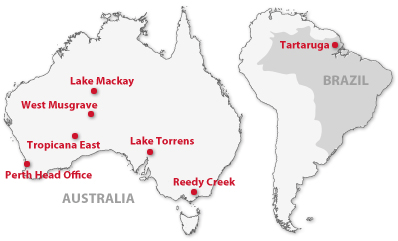
The Tucano Gold Mine was acquired by Beadell Resources Limited in 2010 and is located in Amapá State in northern Brazil. It covers approximately 2,500 km2 of mostly contiguous exploration licences and a mining concession. The nearest major populated centre to the Tucano site is Macapá, situated on the northern bank of the Amazon River.

Beadell resumed mining activities in June 2011 and commenced the construction of the CIL gold plant in July 2011.  


Tucano Gold Mine location map

Development

CIL Process Plant

The Detailed Engineering for the Tucano 3.5 million tonnes per annum CIL process plant commenced in January 2011 with the appointment of the EPCM (Engineering, Procurement, Construction, Management) contractor and was finalised in July 2011.

During the first quarter of 2012, the major civil works were completed for the SAG Mill, Crusher and CIL tanks. From April to September 2012, construction activity increased significantly with the completion of the SAG mill pedestals and the erection of the structural steel for the SAG Mill, surge bin and the ClL tanks. The crusher structural steel was completed in the forth quarter as was all electrical and instrumentation activities.

Ore commissioning into the 7MW SAG Mill commenced on 20 November 2012 and the first gold was poured on 16 December 2012. During the commissioning phase the processing plant has operated at up to 400 tonnes per hour (3.5 million tonnes per annum) equal to the nameplate design.

Mining Operations

Mining operations recommenced at Tucano in June 2011 and initially concentrated on the mining of the two pits in the Tap D valley and the Tap AB eastern wall cutback. In 2012, mining activities were focussed on completion of the TAP D valley pits, as these were the site of the first tailings disposal facility. In addition, the mining of the Tap AB and Tap C pits were advanced to generate stockpiles of ore for early feed to the CIL process plant.

On 20 December 2012, the Tap D tailings facility was completed on time and budget utilising the Tucano mining fleet.

After the start of CIL plant production, mining has been focussed on the extraction of higher grade oxide as feed for the plant. This material was sourced from the Tap AB and Tap C pits.

The mobile equipment fleet was enhanced during the year through the commissioning of four CAT 777G trucks, two CAT 6018 excavators, a Leibherr 964 excavator and a CAT 834 dozer. A further three CAT 777G trucks are due to be commissioned in the first quarter of 2013. Mining productivity was greatly increased by the injection of this new equipment and a corresponding reduction in maintenance costs has also been realised.

At the end of 2012, mining had successfully commenced at the 2.8 million ounce Urucum deposit.

Gold stockpiles as at 31 December 2012 totalled 8.0 Mt @ 0.91 g/t gold for 235,000 oz, which includes a higher grade stockpile of 1.0 Mt @ 1.30 g/t for 43,000 oz.


CAT 6018 Excavator loading a 777G Dump Truck

Duckhead

On 19 October 2012, Beadell confirmed the existence of extremely high grade oxide gold mineralisation at the Duckhead Prospect, located 9 km southeast of the Company’s recently commissioned CIL Gold Plant at Tucano in Brazil. Reverse Circulation drill results included FVM15, 11 m @ 76.5 g/t gold from 103 m including 5 m @ 164.7 g/t gold from 103 m, FVM29, 10 m @ 47.3 g/t gold from 67 m including 4 m @ 115.7 g/t gold from 68 m and FVM31, 8 m @ 40.0 g/t gold from 30 m including 3 m @ 105.7 g/t gold from 30 m. Gold mineralisation is hosted within a completely oxidised shear zone dipping moderately to the southwest on the contact of the main iron ore bearing Banded Iron Formation that links up with the Tucano gold deposits.

On 7 November 2012, Beadell announced an exceptional preliminary open pit resource for the Duckhead deposit at Tucano in Brazil. A JORC Indicated and Inferred resource of 94,000 tonnes @ 30.9 g/t gold for 93,000 oz of gold defining one of the highest grade open pittable resources globally. The high grade lode remains completely open at depth, having only been drilled to less than 100 m below surface.

A second high grade Hangingwall Lode was discovered approximately 100 m to the southeast of the main high grade lode. Drilling results from the Hangingwall Lode included FVM289, 35 m @ 5.6 g/t gold from 33 m including 14 m @ 8.0 g/t gold from 52 m and FVM100, 25 m @ 5.8 g/t gold from 52 m including 12 m @ 10.1 g/t gold from 56 m and HW312, 25 m @ 4.7 g/t gold from 1 m including 10 m @ 8.8 g/t gold from 10 m.

A maiden JORC Indicated and Inferred resource for the Hangingwall Lode of 584,000 tonnes @ 3.8 g/t gold for 71,000 oz remains completely open at depth below the shallow drilling. Combining the Duckhead main high grade lode resource with the Hangingwall Lode resource, the total Duckhead resource totals 678,000 tonnes @ 7.5 g/t gold for 164,000 oz.

A starter open pit reserve for the Duckhead open pit comprising a probable reserve of 70,000 tonnes @ 30.2 g/t gold for 68,000 oz from the Main Lode and 272,000 tonnes @ 3.2 g/t gold for 28,000 oz from the Hangingwall Lode. Total reserves for the Duckhead starter pit is 342,000 tonnes @ 8.7 g/t for 96,000 oz.

Regulatory and Anglo Ferrous approvals to mine the Duckhead starter pit are well advanced with commencement of open pit mining forecast to start in the second quarter of calendar 2013. Inclusion of Duckhead into the 2013 Tucano gold production schedule will have a materially positive effect on head grade into the mill and annual ounce production output. 


Tucano plan showing location of Duckhead and haul road access


Duckhead plan showing location of new grade control results and starter pit


Duckhead long-section showing location of new grade control results and starter pit

Iron Ore 

Iron Ore Concentrate Plant

In March 2012, the Company decided to construct an iron ore concentrate plant at the back end of CIL gold plant to extract high grade iron ore from the CIL tailings. Extensive test work indicated production of ~500,000 tonne per annum of iron concentrate (~65% Fe).

The commissioning of the Iron Ore Concentrate Plant has been delayed by a few months as a result of labour requirements focussing on the timely completion of the CIL gold plant. The plant is now scheduled to produce iron ore concentrate in the second quarter of 2013.

The Iron Ore Concentrate Plant Phase 1 Civils construction was 100% complete at the end of 2012 and only the smaller component of phase 2 Civils remains to be completed (raw water tank base). The majority of the equipment for this project has been procured and on site at the end of 2012.


Iron Ore Concentrate Plant nearing completion

Iron Ore Concentrate Off Take Agreement

The Iron Ore Concentrate Off Take agreement covers the off take of high grade iron concentrate which will be produced from Beadell’s Iron Ore Concentrate Plant positioned at the back end of the CIL Gold plant. Extensive test work indicated production of ~500,000 tonnes per annum of iron ore concentrate at ~65% Fe with very low contaminants. The agreement is for a three year period and the parties may agree to renew for two further terms of three years each.

Joint Operating Agreement (JOA)

The JOA covers a cost recovery agreement for all iron ore mined currently and categorised as ‘waste’ within Beadell’s gold pits above a 25% Fe cut off. Realisation of value for iron ore within the Beadell gold pits will have a materially positive impact on reserves due to the reduction in the strip ratio.

Environment

Beadell is committed to environmentally responsible mining, recognising that the sustainability of its business in the long term depends on good attitudes towards environmental protection and efficient management of the exploration and extraction of mineral resources.

The environmental management system at Tucano has established water monitoring systems and a substantial revegetation nursery in place. The widespread use of hydro seeding of disturbed mining areas for rehabilitation and pit wall slope stability has been extremely successful.

Community

The Tucano gold mine has a long and successful history of social development and support programs and world class environmental governance practices. The Group provides numerous employment opportunities for the local community who fully support the mining activities at Tucano.

In 2012, the Group has continued several social projects that were developed in partnership with the local communities. Beadell’s social projects are in accordance with the “Eight Millennium Development Goals” set by the United Nations in 2000, designed to mobilise countries to improve the quality of life of people.  


Environment Week - Environmental Education Projection - Environment Manager, Marta Rocha, planting an Açaí seedling with teachers


Environment Week - Environmental Education Project - Municipal School Erika Daniela

(1) The potential quantity and grade related to Exploration Targets in this report is conceptual in nature as there has been insufficient exploration to define a Mineral Resource. It is uncertain if further exploration will result in the determination of a Mineral Resource